Almost everything written about real estate up here is about waterfront. Every market report leads with it, every glossy listing photo has a dock in it, and every headline number gets attached to a lake.
I write plenty of it myself. But it's worth saying plainly: most of the homes in this region are not on the water, most of the sales are not waterfront sales, and if you own an ordinary detached house in Barrie, Orillia or Midland, almost none of that coverage is actually about you.
This one is.
The Numbers Nobody Leads With
In July, Simcoe County recorded 483 non-waterfront detached sales, against 32 waterfront sales. That ratio is the whole story of this post. The in-town market isn't a footnote to the waterfront market — it's the overwhelming majority of what actually trades hands, and it gets a fraction of the attention.
That ratio is not the same everywhere, and it is worth being straight about it. Head deeper into cottage country and it flips: in July, Muskoka, Parry Sound and Haliburton each recorded more waterfront sales than non-waterfront ones. Those are genuinely water-driven markets. But across the five regions together, non-waterfront sales still outnumbered waterfront roughly three to one — and in Simcoe County, where most people who read this actually live, it is not close.
The median non-waterfront detached sale in Simcoe County came in at $725,000, at 97% of list price, with a median of 29 days on market. Those are the numbers that describe most people's house. They're not dramatic, which is precisely why they don't make headlines — but they're the ones that matter if you're deciding whether to list this fall.

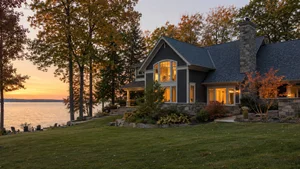
Most of the real estate in cottage country looks a lot more like this than like a boathouse.
Why the Average Price Is Lying to You
Here's the thing that genuinely distorts how people read this market, and once you see it you can't unsee it.
Take Muskoka waterfront in July. The average sale price was $2,114,924. The median was $1,415,000. That is a gap of very nearly $700,000 — the average sitting almost fifty per cent above the middle sale, off 66 transactions.
That is not a rounding error. It is what happens when a handful of genuinely expensive properties close in the same month. The average leaps. The median barely moves, because the median only asks what the middle house did — and the middle house in Muskoka is a long way from the top of that market.
Now think about what that does to a headline. "Cottage country average price hits X" is a sentence built almost entirely out of properties most readers will never own, in a segment that represents a small share of transactions. If you own a three-bedroom in Orillia and you read that number and conclude the market is red hot, you've been misled — not deliberately, but misled all the same.
This is why I lead with the median every time, and why our monthly market report breaks every region into waterfront and non-waterfront rather than blending them. A blended cottage-country average is a number that describes almost nobody.
What This Means If You Own In Town
Two practical consequences.
Don't price off the wrong number. If your sense of what your house is worth came from a regional headline or a neighbour's story about a lakefront sale, it's probably wrong in one direction or the other. The in-town market has its own rhythm, and it usually behaves more steadily than the waterfront market does — fewer spectacular results, fewer disasters.
Your buyer pool is different, and it's bigger. Waterfront buyers are largely discretionary — they're buying a want, and they can wait. In-town buyers are frequently buying a need: a job, a school, a downsize, a family move. Need doesn't wait for the perfect market. That's a meaningful advantage and it's the reason the in-town market tends to hold up when the waterfront market goes quiet.
And If You're Buying
If you've been priced out of waterfront — or you've looked hard at it and concluded the premium isn't worth it for how you'd actually use the place — the in-town market deserves a serious look rather than a consolation-prize look.
You get a year-round house on municipal services, on a maintained road, with a shorter drive to everything and none of the shoreline complexity — no dynamic beach rules, no shore road allowance question, no dock to pull every October. In a lot of these towns you can be a ten-minute walk from public water access for a fraction of what frontage costs.
For a great many people, that's not the compromise. That's the better answer, and they only worked it out after touring both.
Bill's Insider Take
I sell waterfront and I love it. But I've watched a lot of buyers stretch to the absolute edge of what they can afford for frontage they end up using six weekends a year, while the same money bought their friend a better house two streets back with a walk to the beach and no mortgage stress.
Neither choice is wrong. What's wrong is deciding before you've honestly compared them. Go see both. Stand in both. Then decide — and decide based on how you actually live, not on how the listing photos make you feel.
Know Your Own Number
The regional figures in this post describe a market. They don't describe your house, on your street, in its condition.
If you want to know what your place is realistically worth right now — in town or on the water — that's a conversation I'm happy to have with no strings on it. You'll get a straight number and the reasoning behind it.
Lake Country Real Estate Team | eXp Realty | Serving Simcoe County, Muskoka, Parry Sound, Kawartha Lakes & Haliburton