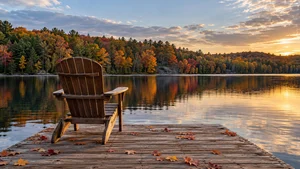
Most lake features start with how the water looks. This one starts with where it goes.
Balsam Lake, in the City of Kawartha Lakes with Coboconk on its north shore, is the summit of the Trent–Severn Waterway — the highest point on the whole 386-kilometre route. Parks Canada puts that summit at 256.20 metres above sea level, which is a long way uphill for a boat that started at Lake Ontario.
The consequence is the interesting part. From Balsam, the waterway runs downhill in both directions.
What that means if you own a dock
It means the boat can go either way. East and south through Rosedale into Cameron Lake and on down the Kawartha chain, or west through the Kirkfield Lift Lock and the Talbot River into Lake Simcoe — and from there, given the time, on to Georgian Bay.
Worth being precise about the water itself: the lake’s main natural outflow is the eastern one, down the Rosedale River. The western leg runs through cut canal. This is a waterway summit rather than a natural watershed divide — but for anyone sitting on a dock with a set of charts, the practical effect is the same. Two directions, real range in each.
The Kirkfield lift lock is worth seeing for its own sake. Parks Canada rates Lock 36 the second-highest hydraulic lift lock in the world, with a lift of about fifteen metres, and unlike the concrete towers at Peterborough it uses open metal frames, so you can watch the whole mechanism work while you are sitting in it.
The Trent–Severn is also a recognized segment of the Great Loop, the circumnavigation of eastern North America by water — roughly 240 miles of a route running to several thousand, so a leg rather than the journey. Still: a dock on Balsam is a dock on that route.
The qualifiers, because they matter
Navigable access is real, and it is not unlimited. Anyone buying with a serious boat in mind should know the constraints before they shop rather than after.
- Vessel size. For a boat intending to run the whole route, Lock 45 at Port Severn sets the ceiling at roughly 84 feet by 23 feet. The Big Chute marine railway further along can carry a larger hull, but Port Severn is the lock that binds a full transit.
- Channel depth. This is the shallower end of the system. Locks 20 through 45 carry a channel depth of 1.8 metres, six feet, against 2.4 metres at the eastern end, and Parks Canada asks operators of vessels drawing five feet or more to contact waterway headquarters before travelling — noting the channel can be less than six feet in places.
- Season, and its edges. In 2026 the lockstations ran from mid-May to 12 October. Parks Canada states plainly that opening and closing times are not guaranteed and can be affected by water management, maintenance or other navigation interruptions. Being “on the system” is a seasonal asset with a soft edge on it, not a guarantee of full-route navigation on any given date.
That is simply the difference between a buyer who arrives informed and one who finds out in July.
The lake itself
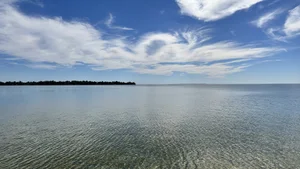
Balsam is big and it is open — roughly 48 square kilometres, fed by the Gull River and the streams running off the Shield to the north, and draining east through the Rosedale River toward Cameron Lake. Balsam Lake Provincial Park sits on the north end.
It is also not a deep lake. Kawartha Conservation’s management plan for Balsam and Cameron puts the average depth at 4.8 metres and the maximum at 14.9 — shallow by Shield standards, and variable across a basin this wide. It holds a warm-water fishery: bass, walleye and muskie. Weed growth varies as well, and depends on more than depth. What any of that amounts to at one particular dock is a property-level question rather than a lake-level one, and it is the first thing I would put a tape measure to.
Open water on a lake this size means fetch. Wind runs a long way across Balsam before it reaches the far shore, so exposure is not a detail here. Which shore you are on, and which way your bay faces, changes what a windy August afternoon is like and what your dock and shoreline have to stand up to.
The part that does not usually make the brochure
Kawartha Conservation publishes a watershed report card for this lake, and it is worth reading precisely because it is not written by anyone selling anything. Their measurements put total phosphorus at 0.010 mg/L — graded B, good — with forest cover at 50.4 per cent and wetland cover at 17.1 per cent, both graded A. There are nine provincially significant wetlands in the watershed, the largest of them Balsam Lake South Bay at 674 hectares.
Two things follow. The first is that on nutrient enrichment — one of the things that bears on nuisance weed and algae growth — there is a published third-party number here rather than an adjective. It is one indicator and not a full account of water quality, and it describes a watershed rather than your bay, but it beats being told a lake is “pristine” by someone with a listing on it.
The second is that those figures describe a catchment with a good deal of forest and wetland still in it. That is a signal about the character of the place, not a promise about any particular shoreline and not a guarantee about the lot behind yours — which is worth checking property by property rather than taking on trust.
What I would check before buying here
- Measure the depth where the boat will actually sit — at the end of the dock, along the approach, and in close — instead of accepting “deep water” as a description. And ask what the weeds are like in August rather than in May.
- Which way the bay faces, and what that means for wind, wave and afternoon sun.
- Whether a shore road allowance affects this property. It is a live question across the Kawartha Lakes and it decides who owns the strip between the lot line and the water. It does not affect every lot — the point is to establish whether it affects this one. I went through it in the Lake Dalrymple feature.
- Winter access. Municipal or private road, who plows, on what arrangement.
- Your actual boat, against the length, beam and depth limits above — before you fall for a property on the strength of where you could take it.
Bill’s Insider Take
Most people buying waterfront are buying a lake. On Balsam you are buying a starting point, and it is the part of this lake that comes up least. If what is at the other end of a long weekend on the water matters to you, that is worth knowing before you decide where to look.
Previously featured: Lakes Muskoka, Couchiching, Simcoe, Rosseau, Kahshe, Six Mile, Joseph and Dalrymple.
Lake Country Real Estate Team | eXp Realty | Serving Simcoe County, Muskoka, Parry Sound, Kawartha Lakes & Haliburton