
Every year, right around the second week of September, the phone changes character. The volume drops and the quality goes up. The people who were “just seeing what’s out there” in July stop calling, and the people who have been watching the same six listings since May start asking when they can get in.
That is the fall market. It is not a slower version of the summer one — it is a different market with a different cast, and it is worth understanding on its own terms rather than as what is left over.
It is also, for my money, the most useful season to actually look at a waterfront property, because in October the place stops flattering itself.
The buyer pool narrows
Summer showings on a lake are part real estate, part day trip. A property that looks like a postcard in the last week of July draws people who are enjoying the drive as much as the house. Some of them are ready. A good number are having an afternoon.
After Labour Day that thins out, and the pattern is consistent enough that I plan my listings around it. The people still driving two hours north on a Saturday in late October have generally seen the summer inventory, know what things trade for, and have decided what they will not compromise on. Fewer showings, and in my experience a better class of question at each one.
The leaves come down
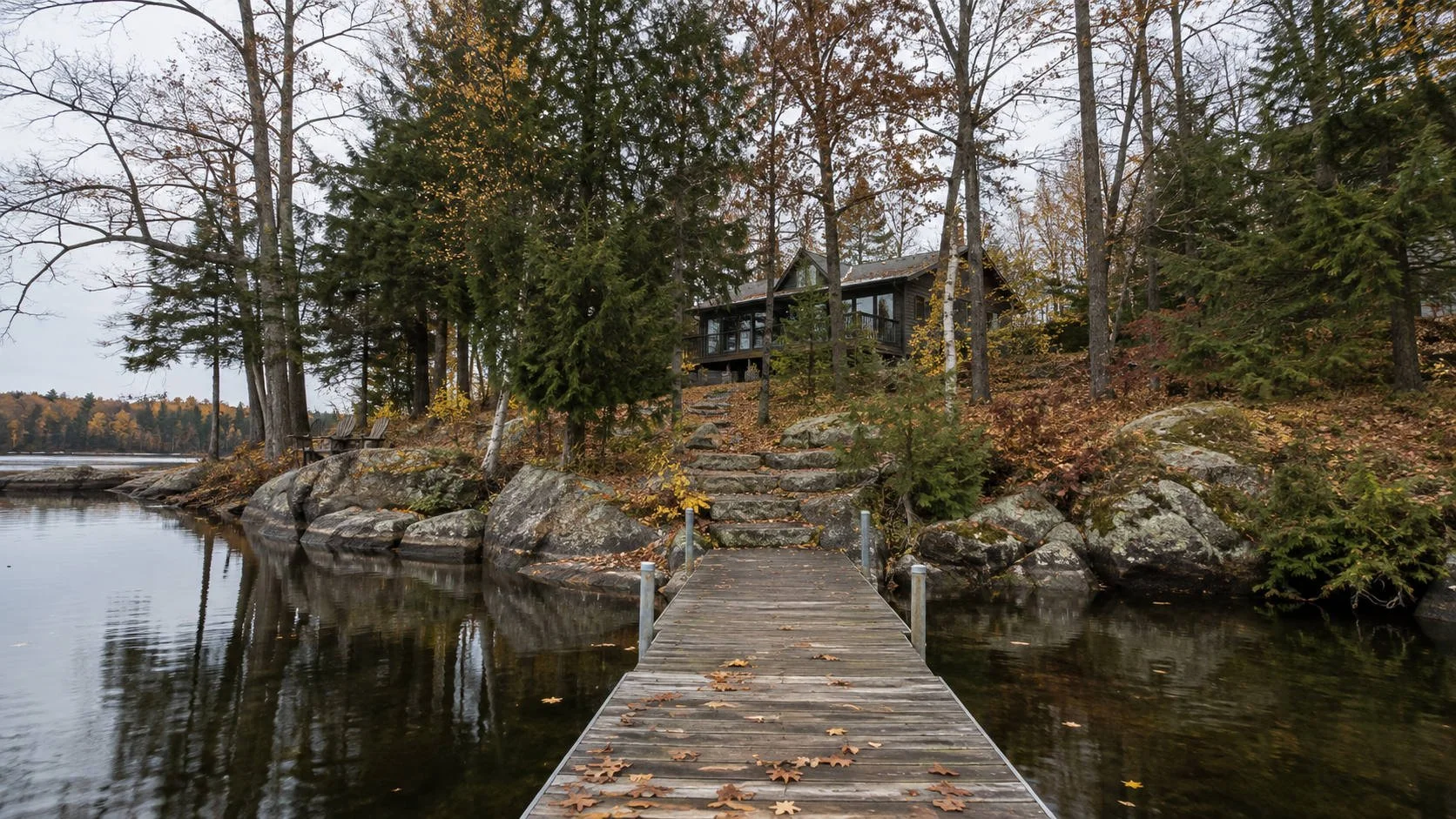
In full leaf, a shoreline lot is generous with what it hides. Once the canopy thins you can see the neighbour’s roofline, the sightline from the road, the cleared areas, the outbuildings and fences, and how much of the privacy you were sold in July was foliage rather than distance.
What bare trees will not show you is where the legal boundary runs. They show you use and occupation, which is a different thing. The boundary lives in the survey, the registered plan and the title documents — not in what you can see from the dock. In this part of the province that distinction earns its keep, because old lot fabric, shore road allowances and long-established encroachments are common enough that a fence line is a starting point for a question, not an answer to one. Look at what October reveals, then have the paper checked.
The ground opens up too. Bare trees and low sun give you a far better read on grade, and if you get there after a rain you can see where the water actually goes — which on a Shield lot, with thin soil over rock, is worth more than any assurance about drainage. The shoreline structures are honest by October as well, because the summer furniture is off them. A dock that looks charming under a beach towel looks like a dock in November.
Access stops being a hypothetical
Getting in and out between December and March matters enormously on a rural or waterfront property, and it is the question most often waved through in July, because everybody is optimistic in a bathing suit.
In October you can drive it, see what the last winter did to the surface, and ask questions that have real answers. In this territory that means, specifically:
- Is the road municipally maintained, or private? This is the fork everything else hangs off.
- If it is private, what is the arrangement, and what form does it take? A road association with a levy, an easement or right-of-way, a registered maintenance agreement, or nothing more than a long habit among neighbours — these are very different things to inherit, and the only way to know which one you are buying into is to have your lawyer look at what is actually registered. Ask what the annual cost has been and whether it has covered the work.
- Who plows, and to where? Some contracts stop at the last shared turnaround rather than at your driveway.
- On a water-access property, where do you actually park, is that spot deeded or leased, and what is the arrangement during freeze-up and ice-out — the weeks each year when the lake carries neither a boat nor a machine?
Every one of those has a document or a person behind it. Get both in front of your lawyer while you still have conditions, not after the deal goes firm.
Systems under load
A home inspector can fire a furnace in August; that is not the point. The point is that August never asks the building to keep anyone warm, and October starts to.
Be honest about what that proves, though. A mild October morning is not a January test — a heat pump that has spent the summer in cooling mode will at least run in heating mode in front of you, but how it holds up in a cold snap is a question for the specifications, the backup heat and a full winter of bills. Autumn buys you a better look and better questions, not a guarantee.
Two documents are worth naming. On a wood-burning appliance, ask for an inspection report from a WETT-certified professional with their certification number on it — WETT certifies people, not appliances, so there is no such thing as a “WETT certificate” or a “WETT-certified installation.” And on the water system, establish whether you are looking at a seasonal lake-draw line or a drilled well: a three-season cottage and a genuine four-season house differ in ways that hide in the water lines, the insulation and the crawlspace. Autumn is when a seller can show you which one you are standing in.
The same holds in town
Most of the above applies to a year-round home in Orillia, Bracebridge or Lindsay, minus the shoreline. The buyer pool sharpens, showings tend to be quieter, and the building is finally being asked to do its job while you are standing in it.
If you are selling this fall
Do not treat it as a consolation prize for having missed the summer — but do set your clock to the right market. In our August figures — median days on market, detached homes, sales 1–31 August 2026, five regions, source The Habistat — waterfront ran between 39 and 51 days against 28 to 42 for non-waterfront. The water took longer in all five regions.
That is a statement about time, not about price. It does not tell you to list higher or lower. It tells you to plan a campaign rather than a three-week sprint, and not to read week four as a failure.
Three things worth doing:
- Have the access answers in writing before you list — road status, maintenance arrangement, plowing, cost. It is one of the questions you will be asked most. A clear one-sentence answer settles it; a vague one leaves it hanging over everything else.
- Have the file assembled — septic record and its rated capacity, well or water system details, permits, any survey, and every rental contract on the property. More on that in this month’s tip.
- Do not strip the colour off the property. Clear the ground, leave the canopy. The autumn look is one of the few things a fall listing gets that a June one does not.
If you are buying
Do the walking while the property is showing you the most. Walk the shoreline. Drive the road, ideally in bad weather. Stand at the road and look back at the house. Then ask for the paper: the road maintenance arrangement, the septic record, the well or water system description, heating costs across a full winter, and any survey that exists.
The property you buy in the fall is closer to the property you will actually own than any version of it you would have met in July.
Bill’s Insider Take
I have shown a lot of the same properties in July and again in October, and they are not the same showing. In July people fall for the view. In October they walk the edges of the lot, look at the road, and ask me about the furnace. Those are better questions.
If you are weighing a specific property this fall — or working out whether yours should go out now or wait for spring — that is worth talking through against the actual numbers for your lake rather than the ones for the region. Call or email me and we will look at it properly.
Lake Country Real Estate Team | eXp Realty | Serving Simcoe County, Muskoka, Parry Sound, Kawartha Lakes & Haliburton